

This site contains affiliate links. We may receive a commission if you make a purchase after clicking on one of these links. See Our Disclaimers for more info.
It’s easy to assume that being good at your job is the safest way to grow your career. But in many workplaces (especially digital media), it can do the exact opposite.
And don’t get me wrong, you should absolutely be good at your job.
But over the years, I’ve noticed something interesting.
Some of the hardest-working, most reliable people I know never seem to move beyond the role they’re already in.
Before they realize it, they’ve become difficult to replace, and the organization starts seeing them as the person for that one specific thing.
In this episode, I break down:
- How being great at your job can accidentally become a career trap
- Why companies keep putting people into roles where they’ve already proven themselves
- Why getting closer to decisions can change how people see your value
- What you can do to make sure your current role doesn’t define your future
The Pattern: Why doing your job well can keep you doing the same job
It’s perfectly logical why good workers often get stuck. The same thing happens all the time in Hollywood.
A movie becomes a massive success, so studios greenlight sequels, reboots, and spin-offs. Not because they’re trying to kill creativity, but because they’re betting on something that’s already proven to work.
Companies operate the same way.
If you consistently solve a particular problem, people naturally keep bringing that problem back to you.
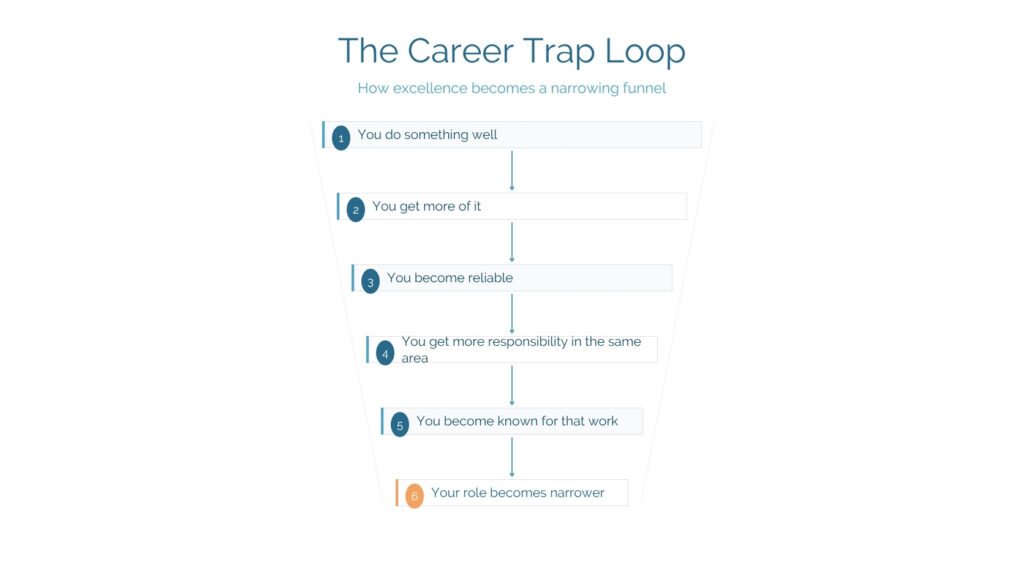
It looks something like this:
- You do something well → you get more of it.
- You become reliable → you get more responsibility in that same area.
- You become consistent → you become known for that work.
Over time, your role starts to narrow.
The frustrating part is that many people don’t even realize it’s happening until they start feeling stuck. That experience isn’t unique to traditional workplaces. A 2025 article from Novelists, Inc. describes how many successful authors eventually reach a point where their careers feel stagnant, despite continuing to produce good work. The work hasn’t necessarily changed, but the pattern has.
That’s usually not because someone is trying to hold you back. It is because the organization is doing exactly what organizations are designed to do: repeat what works.
Once I started looking at it that way, a few moments in my own career made a lot more sense.
Example 1: Reacting Negatively to a less-than-ideal situation
At one point earlier in my career, I got promoted to a manager role at an internet marketing company.
A higher-level position opened up, and I was qualified for it. Everyone I spoke to at the company even said I should get the position. But someone else got it.
I was frustrated. Honestly, I felt like I deserved it.
I blamed ownership. I blamed the manager who got promoted. I convinced myself the system was unfair.
Looking back, some of my frustration was understandable. But the way I handled that frustration was what hurt me.
As the months went on, I stopped caring about the job. My performance slipped, my attitude changed, and eventually I was fired.
Looking back, the promotion wasn’t what hurt my career.
My reaction was.
When things don’t go the way you expect, your response becomes part of the system.
And eventually, the system responds to you.
Example 2: Reacting Differently
A few years later, something similar happened.
I wanted to move into a marketing role at the travel company where I worked. I was qualified, an opportunity opened up, and the company even encouraged internal movement.
When nothing happened, my first instinct was the same as before.
I blamed my manager. I assumed she didn’t want to lose me because I was leading the training team.
But this time I caught myself.
Instead of asking, “Who’s holding me back?”
I started asking, “What can I control?”
I stopped worrying about the position I wanted and focused on doing the best job I could in the position I already had.
Something interesting happened. The frustration disappeared almost immediately.
Then, just a few weeks later, my manager announced she was leaving.
Instead of getting the marketing position I thought I wanted… I inherited her role instead.
- It paid more.
- I learned more.
- And it ended up being a much better fit for my career.
Same company. Same system. Completely different outcome.
The biggest difference wasn’t the organization.
It was my response while nothing seemed to be happening.
The Shift: Stop becoming valuable only for what you already do
For a long time, I thought the answer was to work harder.
I thought I needed to become more valuable by learning another skill or simply taking on more responsibility.
But that’s not what changed my career.
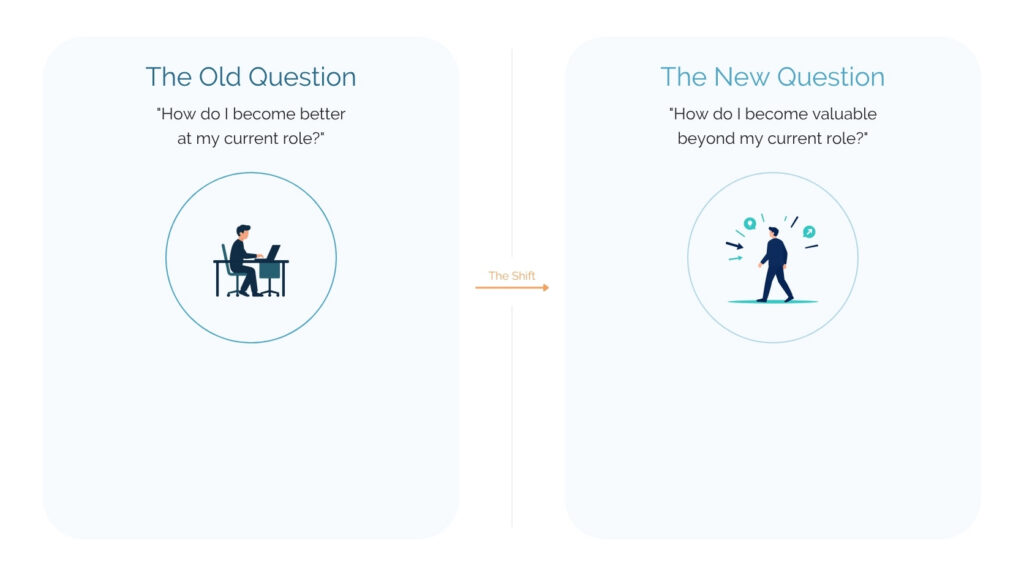
The real shift happened when I stopped asking, “How do I become better at my current role?” and started asking, “How do I become valuable beyond my current role?”
An example of this happened in my current role at McClatchy Media.
When I first started, my focus was the same as most commerce and performance marketing writers: write better articles, grow traffic, improve affiliate revenue, and hit performance goals.
Those things were important, but they weren’t the closest part of the business to revenue.
So instead of asking, “How can I become a better writer?” I started asking, “How can I get closer to the revenue?”
That changed everything.
I learned how sponsored content worked. I started turning PR pitches into partnership opportunities.
Eventually, I moved from simply producing content to managing sponsored content and contributor partnerships tied directly to company revenue.
The interesting part is that I didn’t stop being a writer. I simply expanded what people believed I was capable of contributing.
That’s the shift.
Even a Forbes article from 2025 points to a similar idea: high performers often become so valuable in their current position that organizations struggle to move them somewhere else.
Being valuable isn’t enough anymore. You also have to expand what people believe you’re capable of.
Because if everyone sees you as only the writer, the trainer, or the analyst…
That’s exactly where you’ll stay.
The Leverage: How to expand your value without simply doing more work
The good news is that once you recognize this pattern and shift, you can actually do something about it.
You don’t have to become a different employee.
You don’t have to quit your job.
And you definitely don’t have to stop doing good work.
The goal isn’t to work or care less.
It’s to make sure your value grows faster than the role you’ve been placed in.
That means being intentional about how people see you, what skills you’re developing, and where you’re creating value.
Over time, those small decisions change the opportunities that come your way.
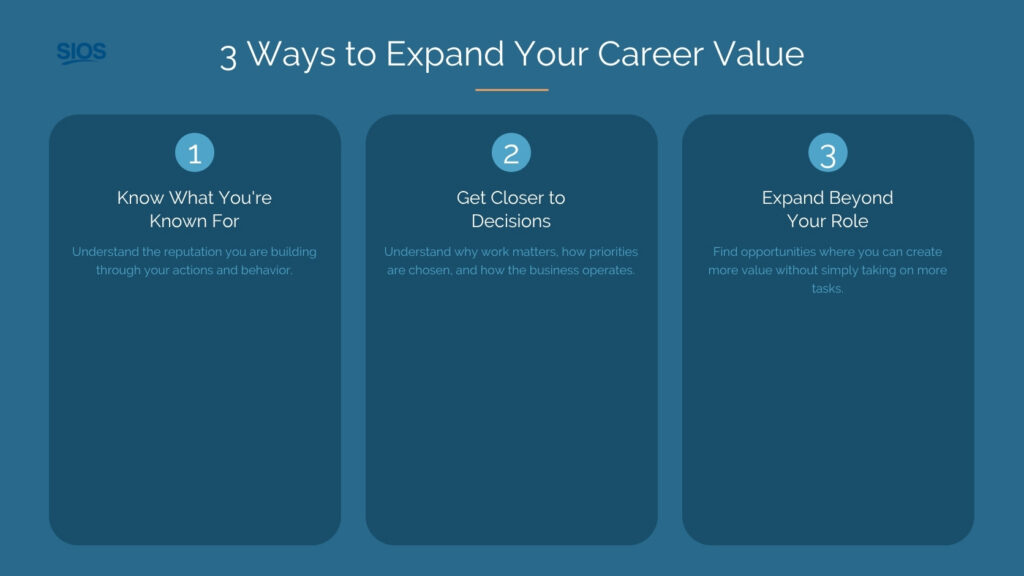
Here are three ways to start doing that.
A quick note before we get into these steps: This doesn’t mean taking on the work of three people or saying yes to every extra responsibility. I’ve heard plenty of people say, “I do the work of three people,” but that’s not leverage. If you’re simply doing more work without increasing your influence, visibility, or compensation, you’re creating value that someone else is capturing. The goal isn’t to work more. It’s to create value in places that change how the business sees you.
3 Actionable Steps: Break Out of the Career Trap
1. Know what you are actually known for
Not your job title.
Your behavior.
What do people consistently come to you for?
- Solving problems?
- Explaining things?
- Staying calm under pressure?
- Getting work done quickly?
Whatever that answer is, the system will naturally keep assigning you more of it.
I’ve noticed this outside of work, too.
For some reason, people constantly stop me in stores like Target or Walmart to ask where something is.
I don’t wear a red shirt. I don’t wear a blue vest.
But somehow, I still get mistaken for an employee.
The same thing has happened throughout my career.
People ask me questions even when I’m not even their manager or editor.
Looking back, I think it’s because I’ve always tried to be approachable and helpful.
That’s what people knew me for.
So, the lesson is simple: Pay attention to what you’re known for, because whether you realize it or not, that’s the reputation you’re building.
2. Get closer to decisions
One thing I’ve learned is that there’s a big difference between doing the work and understanding why the work exists in the first place.
Most people spend their careers focused on the task in front of them.
- Write the article.
- Edit the video.
- Answer the email.
- Meet the deadline.
There’s nothing wrong with that.
The people who grow the fastest usually become curious about what happens before the work reaches their desk.
Who decided this project was important?
How does it make the company money?
Who approved the budget?
Why did this idea get picked over another one?
Those are the conversations that shape the business.
In my own career, I stopped thinking only about writing articles and started thinking about where the revenue actually came from.
That led me to learn sponsored content. It led me to understand partnerships.
Eventually, I found myself much closer to the business side instead of just the production side.
I was still writing, but people no longer saw me as just a writer.
And that’s the point.
You don’t have to become the person making every decision.
You want to understand how those decisions get made.
Because once you understand the business, people stop seeing you as someone who completes tasks.
They start seeing you as someone who helps move the business forward.
3. Don’t let one role become your identity
One of the easiest career traps to fall into is believing your job description defines your contribution.
It doesn’t.
Your job description explains what you’re responsible for today. It doesn’t define where you can create value tomorrow.
A good example of this happened in my current role at McClatchy Media.
Every day, my inbox was filled with PR pitches from companies looking for editorial coverage.
It would have been easy to just delete them or treat them as just another part of the workflow.
But I kept thinking,
“There’s probably more value here.”
Those companies weren’t just looking for editorial coverage. Some of them were potential advertising partners.
Before I did anything, I talked to my managers. I wanted to make sure I wasn’t stepping on anyone’s toes or creating work that wasn’t actually helpful.
Once we agreed it made sense, I started identifying qualified partnership opportunities and sending them to our sales team.
None of that was in my job description. I was still doing the work I was hired to do.
I simply started paying attention to opportunities that my role naturally exposed me to.
That’s the habit I’d encourage you to build.
Don’t just ask,
“What am I responsible for?”
Also ask,
“What opportunities can I see because of where I sit?”
Sometimes the biggest opportunity isn’t outside your role.
It’s sitting right under your nose. You just haven’t recognized it yet.
Your Career Growth Depends on What You’re Known For
The biggest lesson I’ve learned is that career growth isn’t just about becoming better at your job.
It’s about making sure your value continues to grow beyond the role you’re currently in.
That’s what helped me stop thinking like a writer and start thinking like someone who could contribute to the business in different ways.
Once people begin to see you differently, new opportunities start to appear.
And the people who create these opportunities are usually not strangers. They’re people who already have an opinion about your work, your attitude, and what you’re capable of.
That reputation is one of the most valuable career assets you can build.
And that’s exactly what I’ll explore in the next episode: the hidden skill that makes people think of you first.
Thanks for reading,
Nick Hazleton
Watch this topic on YouTube here